
How Might We Navigate Geopolitics with Leadership?
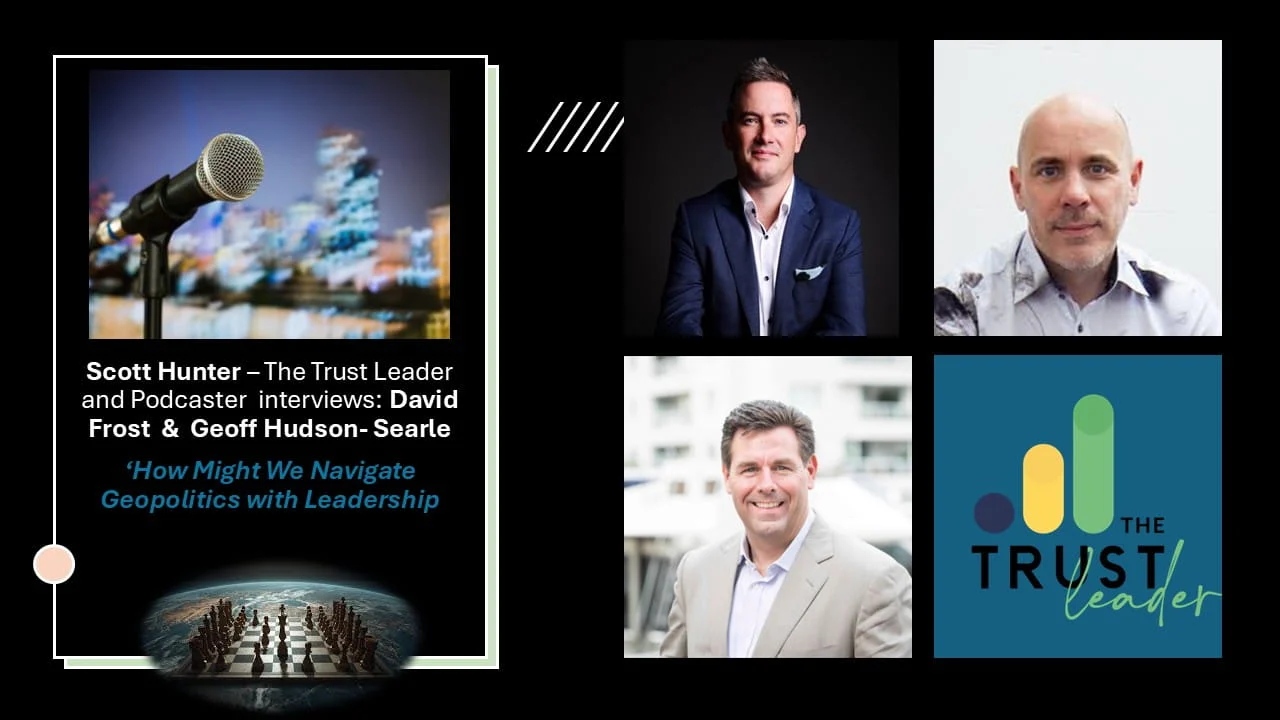
This latest podcast Scott Hunter – The Trust Leader and Podcaster interviews: David Frost & Geoff Hudson- Searle ‘How Might We Navigate Geopolitics with Leadership”
Boards and CEOs must shift from a reactive “wait and watch” approach to adopting bold, proactive measures to manage escalating geopolitical risks. This involves elevating geopolitics from a compliance issue to a central pillar of corporate strategy, integrating it into decision-making to build long-term resilience. Many organisations are accelerating their digital transformation agendas in evolving markets, rising geopolitical tensions, and increased competition.
Over the last year, the word on everyone’s lips has been resilience and boldness— the ability to navigate changing environments and manage adversity, with endurance and emotional intelligence. In addition to resilience, the World Economic Forum’s Future of Jobs Report 2025 highlights analytical thinking, leadership and social influence, and creative thinking, among others, as core skills amid the geoeconomic fragmentation and geopolitical tensions of 2025.
Everyone is discussing big trust, however, there is no return to the old stability. Restructuring, hybrid work, and economic pressure are not temporary phases; they are the new context of a trusted leader, but the human ability to respond with clarity, dignity, and courage remains intact. Trust will not rebuild itself by words, but it can be rebuilt – relationship by relationship, interaction by interaction – when realistic optimism is practiced from the inside out and clear measurable results prove this fact.
Not the kind of optimism that says, “everything will be fine.” But one that says: “We can meet what comes with presence and humanity.” That kind of optimism doesn’t eliminate uncertainty, but it does restore trust. Investment in new technologies, advanced systems, and innovative business models has become a strategic priority. Yet transformation initiatives frequently fall short of their intended impact. The challenge is rarely technological. It is human.
Employees face uncertainty. Senior and middle management is required to operate differently. Leaders often underestimate the scale of cultural change needed to embed new ways of working. When organisational culture is not aligned with strategy, momentum weakens. Resistance grows. Execution fragments. What should enable progress becomes a source of friction. By enhancing leadership communication, building confidence at every level, and creating shared clarity, transformation becomes intentional, bold, sustained, and measurable.