
THE IBEM TRUST MODEL
THE IBEM TRUST MISSION: WHY TRUST IN BUSINESS IS MORE IMPORTANT THAN EVER
Amid economic turbulence and global uncertainty, people are increasingly turning to their employers and business leaders as a source of truth, rather than their institutions and government officials. Trust, which can be defined as a belief in the abilities, integrity, and character of another person, is often thought of as something that personal relationships are built on.

In our minds, trust is at the foundation of healthy relationships and in business relationships, healthy ones, are everything.
At its core, trust is the willingness of one party to be vulnerable to the actions of another.
It is an expectation that two parties will act in a way that is mutually beneficial.
For these reasons, trust is a key element of effective communication, teamwork, employee commitment and productivity. It leads to stronger working relationships and a healthier organizational culture.
We know that trust is the glue that holds teams together and creates positive, productive workplaces. In fact, we often hear that trust must be earned, that to trust means showing vulnerability, or that it can be hard to build and sustain, and easy to break. However, trust is and remains one of the least understood factors essential to business.
So, where to start? Perhaps with ourselves and two simple, yet profoundly powerful, questions:
How much trust do you have in your professional and personal relationships?
How do you build more trust if it’s lacking?
TRUST: A LEADERSHIP IMPERATIVE
Trust is the currency of leadership.
When you have established trust with the people around you, you are a more effective and efficient leader. You will be more effective because you will encounter less resistance to your ideas and will be able to achieve results faster. You will also be more efficient because you will be able to produce these results using less of your time and energy.

Every interaction we have with another person is either placing a deposit or making a withdrawal in their emotional bank account. When you make regular deposits, it creates a positive balance, and there is trust. When we make too many withdrawals, we become overdrawn, which results in distrust.
Trust helps to make challenging conversations easier, teams more integrated, and employees more engaged. Exploring ways in which trust can be genuinely built can help individuals, teams and ultimately entire organisations create stronger relationships and healthier cultures.
TRUST: AN ORGANISATIONAL IMPERATIVE
Business literature is replete with examples, myriad studies positing that trust within organisations boosts productivity and employee engagement, helps leaders and teams to focus on what is important and reduces friction. However, business is facing an existential trust crisis. Furthermore, regular news features show how some of the world’s leading organisations are losing the public’s faith.
Recently, more attention has been paid to the issue of cross-generational perspectives on trust. Generally, this literature highlights that whilst organisational trust is particularly important to the young people – it is at an all-time low.

So, it’s no surprise that transparency, enablement and a culture of trust boost Gen Z and Millennial’s loyalty and commitment, while a lack thereof, can be a primary reason to leave an employer.
Therefore, building trust within organisations is not only key to withstanding current challenges, but will pay off in the future.
But where there is a crisis, there is an opportunity, too – the faltering confidence in business is not only a call to regulators; it is also clearing the way for trust as a differentiator.
So, the smart question here is – how can business leaders turn trust into a competitive advantage?

THE TRUST LEADER PLATFORM
Growth puts trust under pressure. As businesses scale, the informal relationships and close communication that once held everything together are no longer enough. More people, more clients, more decisions and more complexity create more room for assumptions, inconsistency and missed expectations. The Trust Leader platform helps growing businesses make trust visible, practical and measurable by focusing on the everyday behaviours that shape communication, follow-through, accountability and client confidence.
Our platform supports trust mapping, self-assessment, targeted activity playlists and reflection, helping leaders and teams identify where trust needs to be strengthened and take action in the flow of work. It is designed to build habits, not just awareness. By linking trust gaps to clear behaviours and repeatable activities, The Trust Leader helps businesses strengthen trust inside the organisation and with the clients they serve, with limited disruption to day-to-day performance.
IBEM RISING UP TO THE TRUST CHALLENGE
Four strategic options are crystalising in this new paradigm of trust.
One is about trust as a product strategy; the second is about trust as a service; the third is about trust as a platform strategy; the fourth is about open architectures that help all actors up their trust game.
Trust is the operating system of successful societies. Its erosion in the face of unprecedented levels of corporate power and a perceived surge of intended and unintended corporate wrongdoings gave rise to a new ecosystem of trust champions, brokers, platforms and architects.

Market leaders need to tap into this ecosystem to make sure they don’t jeopardise their competitive edge by losing their public’s faith; smaller actors may enjoy greater societal trust but face the mammoth challenge of converting their trust advantage into a competitive advantage.
But the game of trust is not a zero-sum game. Trust is not a resource that is depleted with use. It is a muscle that gets stronger with exercise. The trust crisis is thus a trust opportunity, too; an opportunity to build an operating system for more cohesive and sustainable societies.
READ THE TRUST PARADIGM
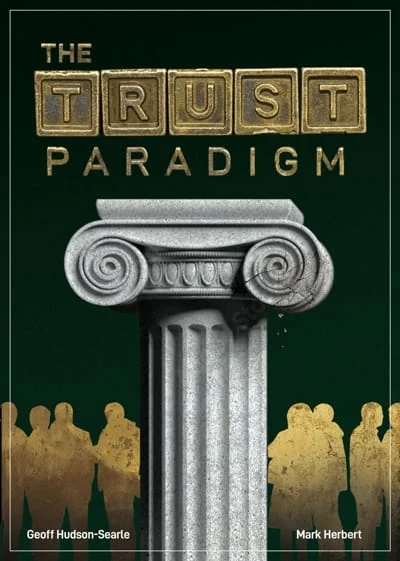
It is clear that executive leaders have more work to do to leverage the power of trust in their organisations, and this presents the opportunity for new paradigms. To support decision makers in deliberately strengthening relationships founded on trust within organisations, and to lead with the next generation in mind, IBEM have synthesised a comprehensive trust model.
The IBEM Trust Model provides a holistic view of trust-building measures along three guiding principles:
First, transparency is key. Trust increases if the organisation’s goals are aligned with a coherent overall strategy and leaders communicate authentically in an honest, realistic and targeted manner.
Second, enablement of the organisation with the least surveillance and control mechanisms creates ownership and fosters positive behaviours.
We advise employing simple, well-reasoned principles instead of complex and rigid rules to encourage an output-oriented mindset and to consider individuals’ specific situations and needs.
A high-trust organisation is one in which employees feel safe to take risks, express themselves freely, and innovate. When trust is instilled in an organisation, tasks get accomplished with less difficulty because people are more likely to collaborate and communicate with each other in productive ways. As a result, outcomes tend to be more successful. No heroic leader can resolve the complex challenges we face today. To address the important issues of our time we need a fundamental change of perspective. We need to start questioning many of our taken for granted assumptions about our business and social environment.
Growth puts trust under pressure. As businesses scale, the informal relationships and close communication that once held everything together are no longer enough. More people, more clients, more decisions and more complexity create more room for assumptions, inconsistency and missed expectations. The Trust Leader platform helps growing businesses make trust visible, practical and measurable by focusing on the everyday behaviours that shape communication, follow-through, accountability and client confidence.
Our platform supports trust mapping, self-assessment, targeted activity playlists and reflection, helping leaders and teams identify where trust needs to be strengthened and take action in the flow of work. It is designed to build habits, not just awareness. By linking trust gaps to clear behaviours and repeatable activities, The Trust Leader helps businesses strengthen trust inside the organisation and with the clients they serve, with limited disruption to day-to-day performance.